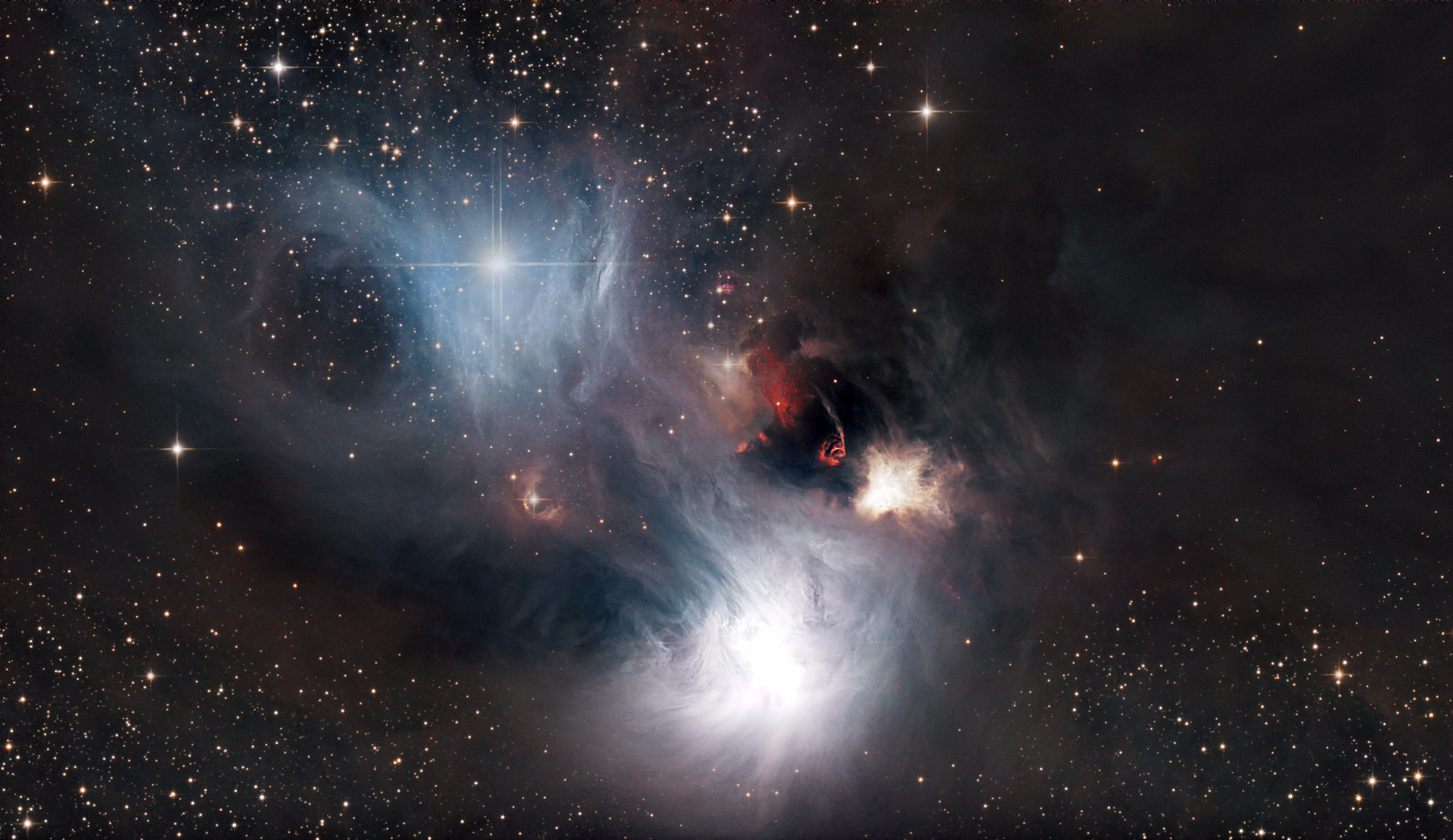
Deep within the molecular clouds of Corona Australis, young stars illuminate the surrounding dust in soft reflected light, revealing one of the nearest stellar nurseries to Earth. This portrait of NGC 6726 and NGC 6727 captures the delicate interplay between luminous blue reflection nebulae, dark interstellar dust, and faint hydrogen emission woven through the heart of the Milky Way.
Reflections in Corona Australis
Located deep within the dusty molecular clouds of Corona Australis, NGC 6726 and NGC 6727 are part of one of the nearest active star-forming regions to Earth. Unlike emission nebulae that glow from ionised gas, these nebulae shine primarily by reflecting the light of nearby young stars, producing their characteristic blue appearance. This region is rich in dark molecular dust, reflection nebulosity, and embedded protostellar activity. The dense clouds visible throughout the frame are composed of cold interstellar dust that obscures background starlight while simultaneously shaping the surrounding nebula through stellar radiation and winds. At the heart of the image, subtle red hydrogen emission contrasts against the cool blue reflection clouds, revealing areas where energetic young stars interact with the surrounding material. The intricate dust structures and flowing patterns are signatures of an active and evolving stellar nursery. The image was processed with a restrained and natural approach, emphasising depth, luminosity, and the delicate texture of the surrounding dust rather than aggressive contrast or saturation. Careful control of stellar intensity allowed the faint reflection structures and dark molecular clouds to remain visually dominant, preserving the soft, atmospheric character that defines this region of space. Special attention was given to maintaining smooth tonal transitions within the brightest reflection cores while revealing the subtle filamentary detail embedded throughout the nebula. Captured from the southern skies, this image reveals the delicate balance between light and darkness inside one of the Milky Way’s most beautiful and complex interstellar environments.
You may also like