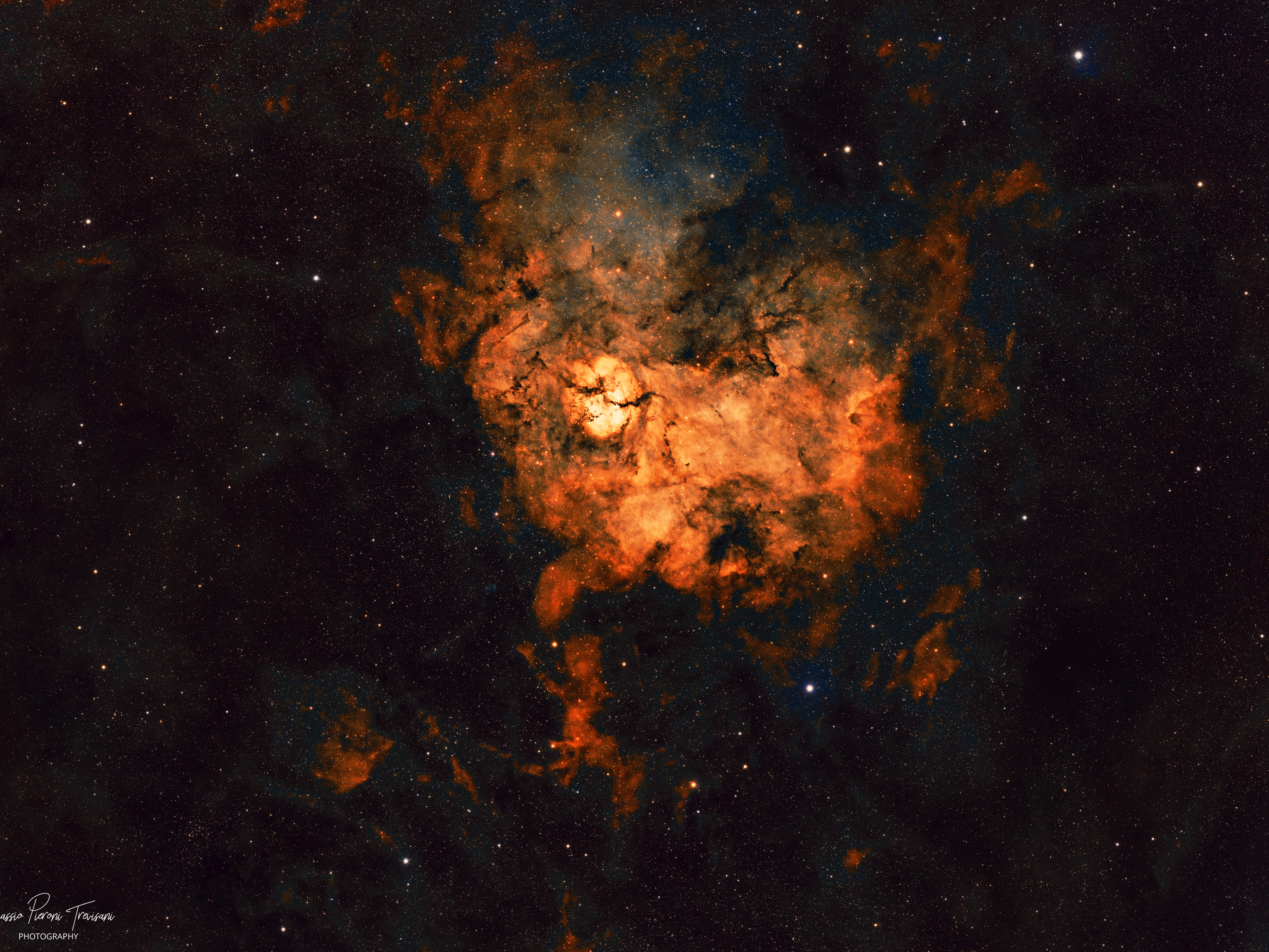
A glowing heart of hydrogen light, beating softly across the dark skies of Cassiopeia.

Last Saturday, from the elevated vantage point of Bignor Hill in the South Downs, I spent just over an hour capturing this view of the Heart Nebula (IC 1805), a vast emission region nestled in Cassiopeia. Using a Seestar S30 Pro, I gathered 63 exposures of 60 seconds each, building up enough signal to reveal the delicate structure of this iconic deep-sky object. The nebula’s deep red glow comes from ionized hydrogen, energized by a cluster of young, massive stars at its core. Their radiation sculpts the surrounding gas into sweeping arcs and cavities, while darker dust lanes weave through the scene, adding contrast and depth. Even with a relatively modest total integration time, the aim was to balance structure and softness—bringing out the faint outer edges of the “heart” while preserving a gentle, internal luminosity across the nebula. From this quiet spot in the South Downs, the data came together to reveal not just the familiar heart-shaped outline, but also the subtle interplay between light and shadow that gives this region its sense of scale and life.
A glowing heart of hydrogen light, beating softly across the dark skies of Cassiopeia.