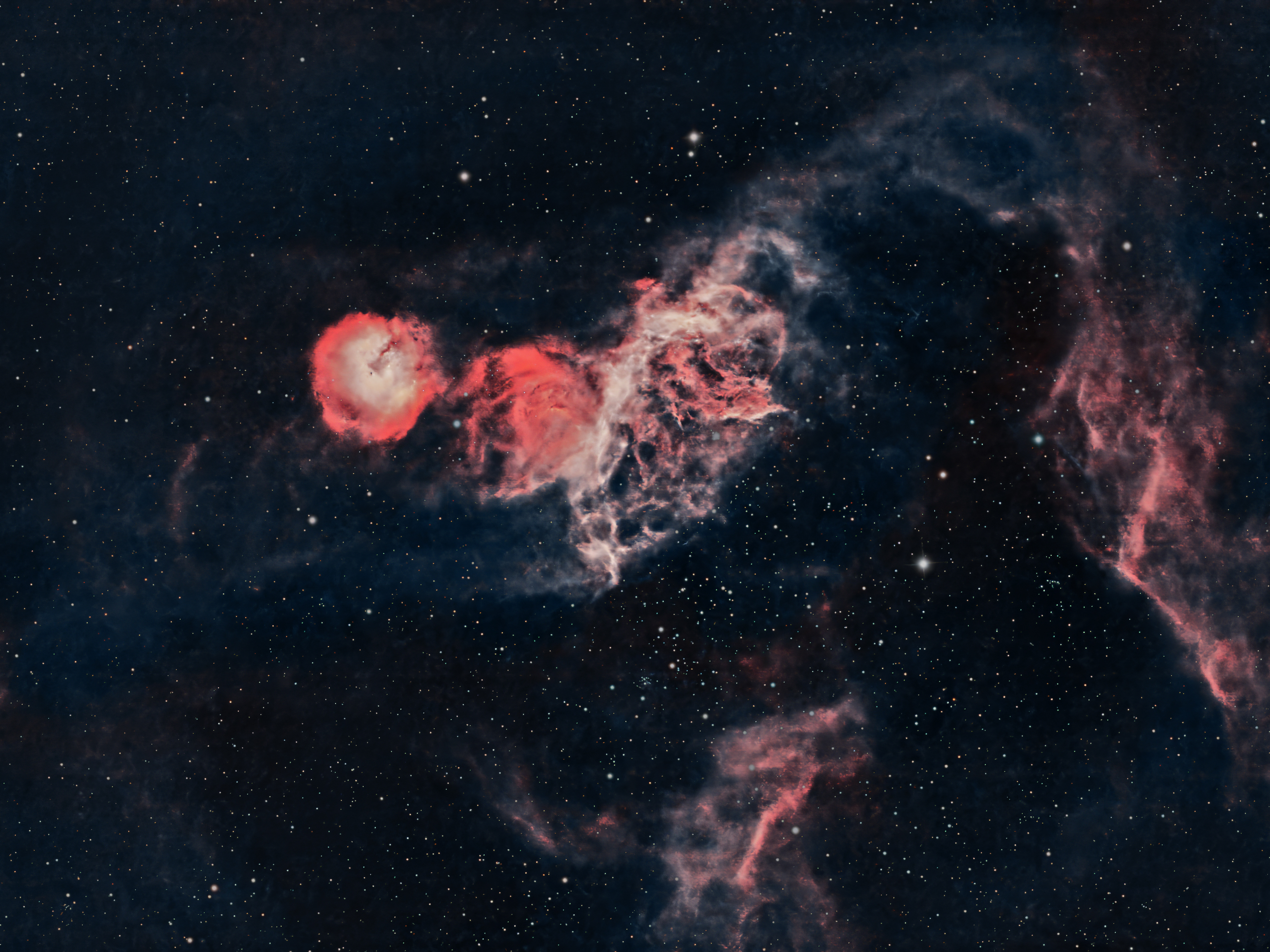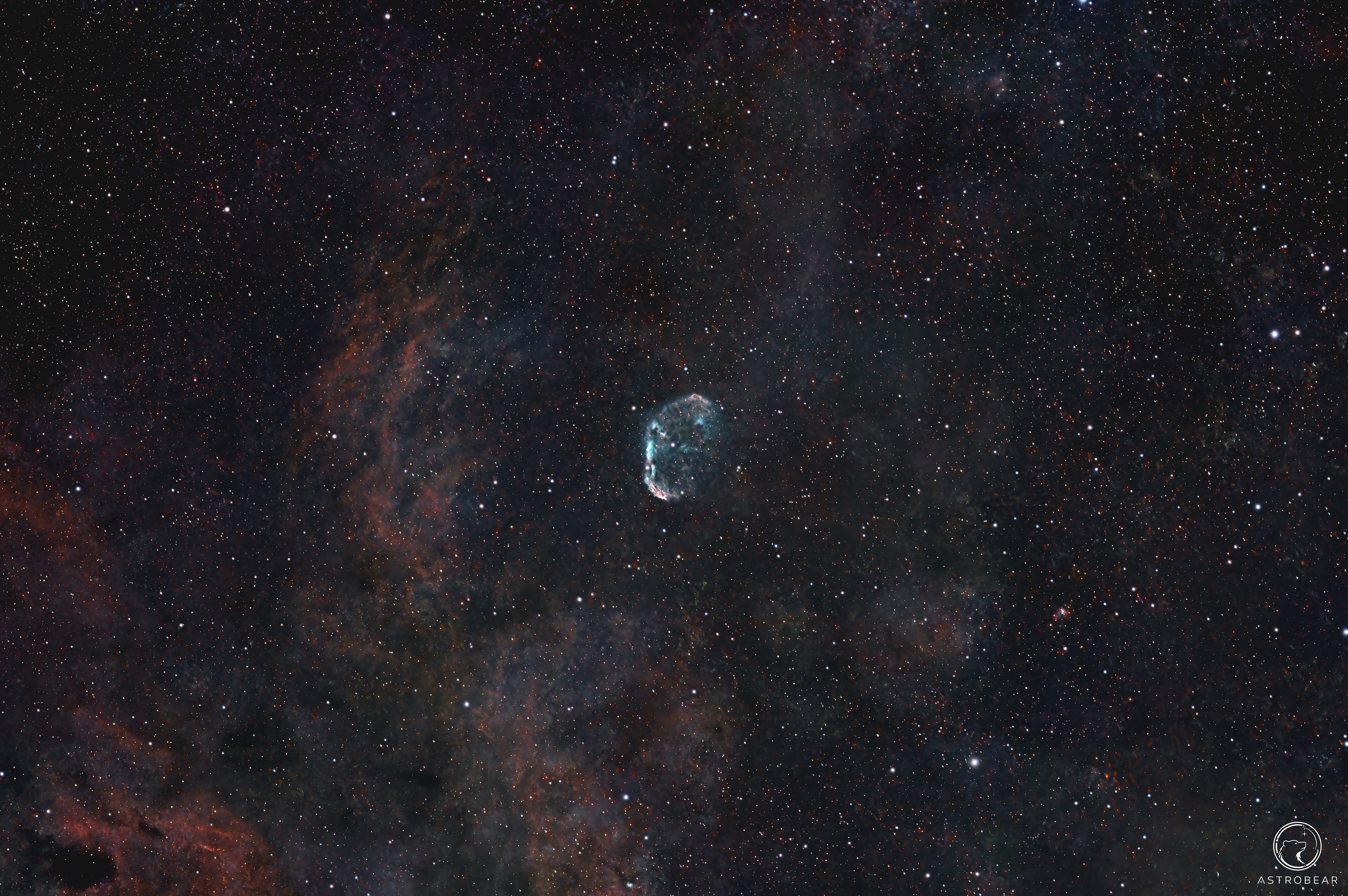

A wide-field view of NGC 6888 (the Crescent Nebula) and the surrounding complex of faint emission nebulosity in Cygnus, captured last night from Bignor Hill, South Downs, UK. The dataset combines broadband RGB with dual narrowband Ha/O III and SII/O III data. The broadband data provides the natural stellar continuum and colour information, while the narrowband integrations were used to increase the signal and structural definition within the surrounding emission and the shell of NGC 6888. The ASKAR C1 Ha/OIII data isolates the strong Hα emission throughout the field while also recording the OIII signal associated with the Crescent's shock-excited shell. The ASKAR C2 SII/OIII data adds SII information while providing an additional OIII dataset. Combining both dual-band filters increases the available OIII integration while allowing the Ha, SII and OIII components to be treated separately during processing. The broadband UV/IR-cut data were retained primarily for the stellar continuum and natural star colour, avoiding the strongly modified stellar colours produced by the narrowband filters. NGC 6888 is a wind-blown Wolf-Rayet nebula surrounding WR 136. Fast stellar winds from WR 136 are colliding with material expelled during earlier evolutionary phases of the star. This interaction produces the expanding, filamentary shell, with particularly strong OIII emission tracing the shock front around portions of the nebula. The wide field also reveals the much fainter diffuse Hα/SII emission across the Cygnus region, giving context to NGC 6888 and showing that the Crescent is embedded within a considerably larger and more complex ionised environment. The processing was aimed at maintaining that distinction: natural broadband stars, subdued large-scale Ha/SII emission, and stronger OIII definition within the Crescent, without allowing NGC 6888 to become disconnected visually from the surrounding field.