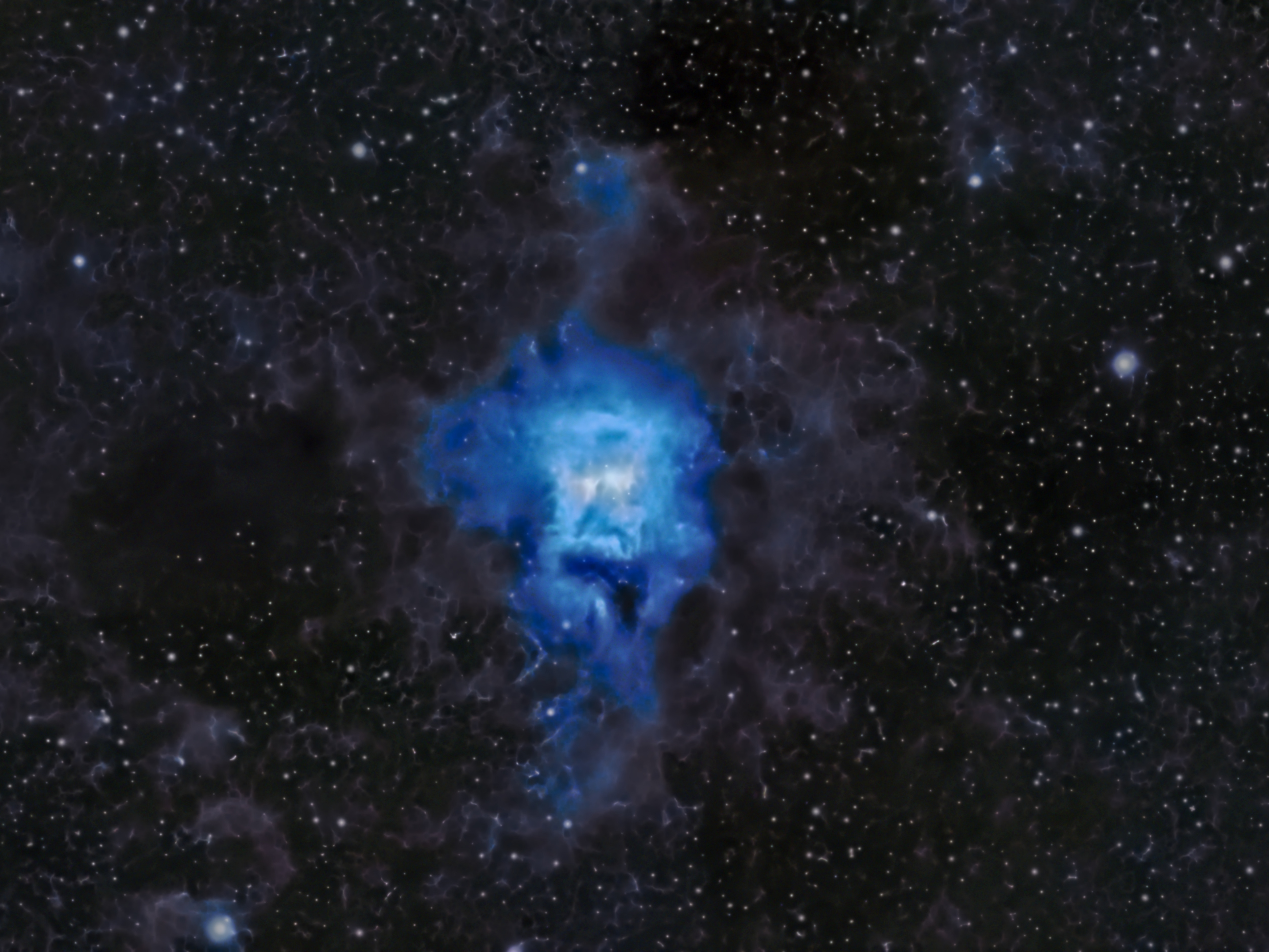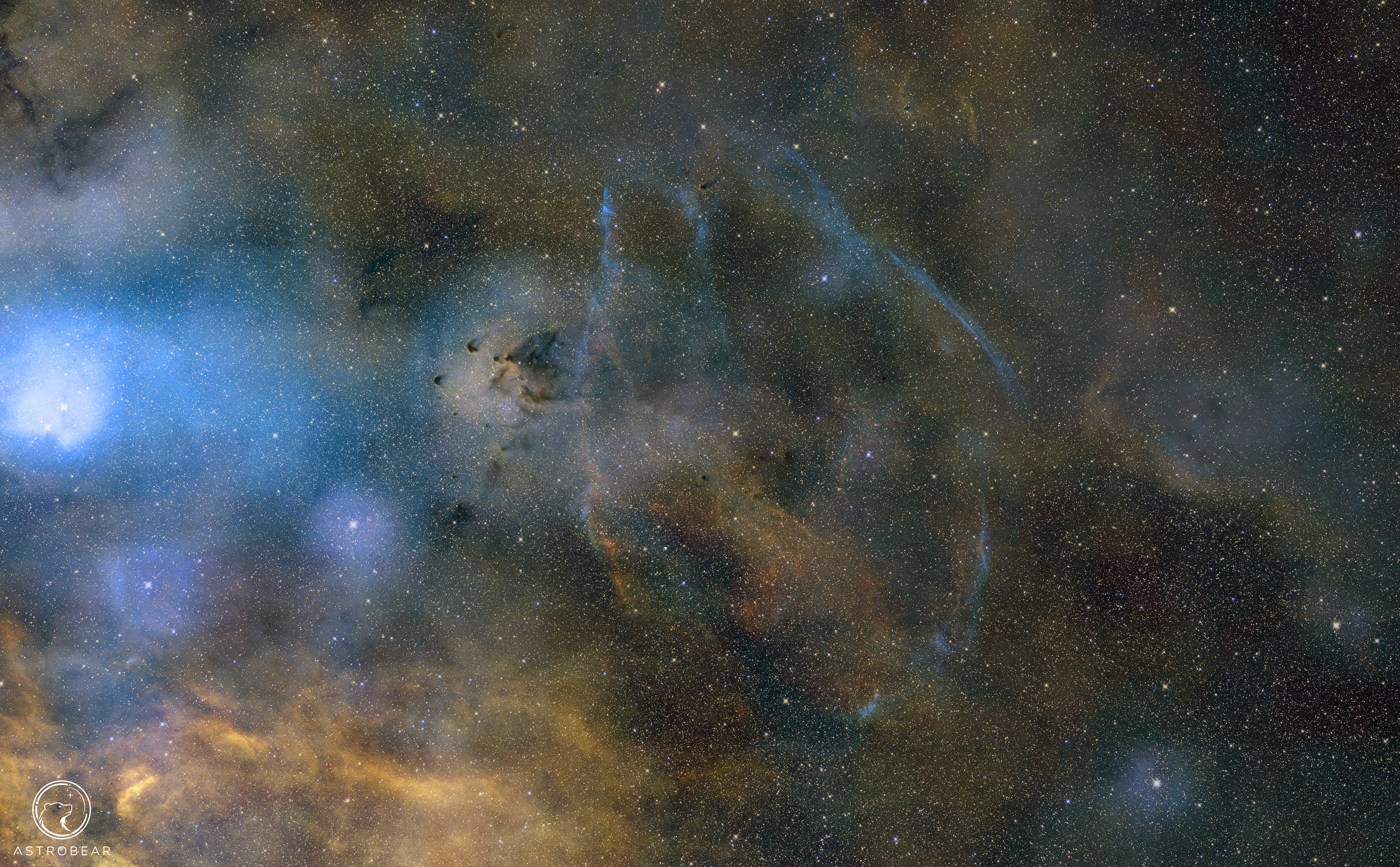

Hidden within an extraordinarily rich region of the southern Milky Way, G321.3−3.9 is an extremely faint supernova-remnant candidate situated in Triangulum Australe. Its delicate shell is easily overwhelmed by the dense stellar field, molecular clouds and complex emission associated with the nearby Circinus OB region. Despite having only a limited amount of data, I was able to reveal much of the remnant’s ghostly blue OIII structure. The brightest filaments trace a fragmented shell across the image, appearing almost suspended above the darker clouds and warmer Galactic dust. The surrounding field is every bit as fascinating as the remnant itself, filled with overlapping layers of reflection, absorption and emission nebulosity. Processing this image was a considerable balancing act. The signal from the remnant is exceptionally weak, so I wanted to bring it forward without suppressing the natural complexity of the background or pushing the data beyond what it could support. There is still some noise present, but I preferred to retain the delicate structures rather than apply overly aggressive smoothing. G321.3−3.9 was initially identified through radio observations. Deep optical imaging later revealed an OIII shell measuring approximately 1.8 × 1.1 degrees, closely corresponding with its radio morphology and providing strong evidence for its supernova-remnant nature. Its faint optical filaments were first recorded only relatively recently, making this a particularly challenging and fascinating object to process. Scientific and discovery background Although I would like to return to this object with considerably more integration time, I am pleased with how much of this elusive remnant emerged from the limited data—a hidden relic of a stellar explosion slowly revealing itself through the dust of the Milky Way.